Tuesday, July 29, 2008

Water On The Moon?


A new finding by a team from the Carnegie Institution for Science in Washington, who developed a new piece of technology called ion mass spectrometry; found a presence of water in Moon rock at levels not previously thought possible.

Jim Van Orman, a professor in the geological sciences department at Case Western Reserve University said the findings suggest the water came from the moon’s interior and was delivered to the surface of the moon through volcanic eruptions.

“Water contains the essential ingredients used for rocket fuel,” Van Orman said in a statement. “Certainly, if there is ice on the moon’s polar caps, that could be used. But if there is water in the rocks –and as much as our studies infer– that is another resource that could be tapped.”

Researchers said finding water on the moon may have a great benefit for future exploration to the universe; the moon might be the lunching point to other planets. They said.

Monday, July 21, 2008

TAINTED UPA: VEERAPPA MOILY (IN CHARGE CONGRESS KERALA)

Moily was former Karnataka Chief Minister & was jailed many months for corruption he did during his minister ship in Karnataka. Most infamous of his scandals includes TIMBER scam where in he involved illegal moving of Karnataka forest wealth across border. While he was in charge of Kerala Congress election committee he tried to sell many congress seats to unqualified candidates by taking money from them. Others includes now infamous Cogentrix deal. Many other charges are under CBI investigation.

Cases Against Moily

1. Stamp Paper (Telgi’s) Scam

2. Timber Scam

3. Computer Scam

4. Congress Ticket for Money Scam

5. Cogentrix Scam

6. Disproportionate Wealth Case

Saturday, July 19, 2008

SEVEN WONDERS OF THE WORLD - HANGING GARDENS OF BABYLON

The ancient city of Babylon, under King Nebuchadnezzar II, must have been a wonder to the traveler's eyes. "In addition to its size," wrote Herodotus, a historian in 450 BC, "Babylon surpasses in splendor any city in the known world."


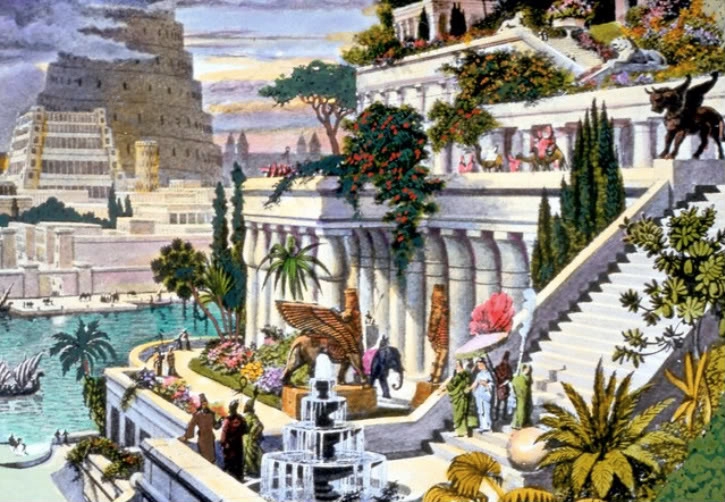
This hand-coloured engraving by the 16th-century Dutch artist Martin Heemskerck depicts the fabled Hanging Gardens of Babylon, one of the Seven Wonders of the World. According to the tradition, the gardens did not hang, but grew on the roofs and terraces of the royal palace in Babylon. Nebuchadnezzar II, the Chaldean king, is supposed to have had the gardens built in about 600 BCE as a consolation to his Median wife, who missed the natural surroundings of her homeland. The Tower of Babel stands in the background.
Herodotus claimed the outer walls were 56 miles in length, 80 feet thick and 320 feet high. Wide enough, he said, to allow a four-horse chariot to turn. The inner walls were "not so thick as the first, but hardly less strong." Inside the walls were fortresses and temples containing immense statues of solid gold. Rising above the city was the famous Tower of Babel, a temple to the god Marduk, that seemed to reach to the heavens.

While archaeological examination has disputed some of Herodotus's claims (the outer walls seem to be only 10 miles long and not nearly as high) his narrative does give us a sense of how awesome the features of the city appeared to those that visited it. Interestingly enough, though, one of the city's most spectacular sites is not even mentioned by Herodotus: The Hanging Gardens of Babylon, one of the Seven Wonders of the Ancient World.

Accounts indicate that the garden was built by King Nebuchadnezzar, who ruled the city for 43 years starting in 605 BC (There is a less-reliable, alternative story that the gardens were built by the Assyrian Queen Semiramis during her five year reign starting in 810 BC). This was the height of the city's power and influence and King Nebuchadnezzar constructed an astonishing array of temples, streets, palaces and walls.

According to accounts, the gardens were built to cheer up Nebuchadnezzar's homesick wife, Amyitis. Amyitis, daughter of the king of the Medes, was married to Nebuchadnezzar to create an alliance between the nations. The land she came from, though, was green, rugged and mountainous, and she found the flat, sun-baked terrain of Mesopotamia depressing. The king decided to recreate her homeland by building an artificial mountain with rooftop gardens.

The Hanging Gardens probably did not really "hang" in the sense of being suspended from cables or ropes. The name comes from an inexact translation of the Greek word kremastos or the Latin word pensilis, which mean not just "hanging", but "overhanging" as in the case of a terrace or balcony.

The Greek geographer Strabo, who described the gardens in first century BC, wrote, "It consists of vaulted terraces raised one above another, and resting upon cube-shaped pillars. These are hollow and filled with earth to allow trees of the largest size to be planted. The pillars, the vaults, and terraces are constructed of baked brick and asphalt."

"The ascent to the highest story is by stairs, and at their side are water engines, by means of which persons, appointed expressly for the purpose, are continually employed in raising water from the Euphrates into the garden."

Strabo touchs on what, to the ancients, was probably the most amazing part of the garden. Babylon rarely received rain and for the garden to survive it would have had to been irrigated by using water from the nearby Euphrates River. That meant lifting the water far into the air so it could flow down through the terraces, watering the plants at each level. This was probably done by means of a "chain pump."

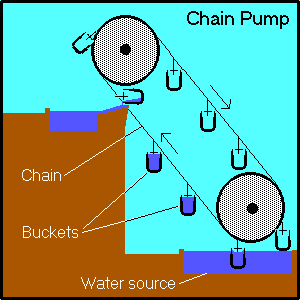
A chain pump is two large wheels, one above the other, connected by a chain. On the chain arehung buckets. Below the bottom wheel is a pool with the water source. As the wheel is turned, the buckets dip into the pool and pick up water. The chain then lifts them to the upper wheel, where the buckets are tipped and dumped into an upper pool. The chain then carries the empty ones back down to be refilled.

The pool at the top of the gardens could then be released by gates into channels which acted as artificial streams to water the gardens. The pump wheel below was attached to a shaft and a handle. By turning the handle slaves provided the power to run the contraption.

Construction of the garden wasn't only complicated by getting the water up to the top, but also by having to avoid having the liquid ruin the foundation once it was released. Since stone was difficult to get on the Mesopotamian plain, most of the architecture in Babel utilized brick. The bricks were composed of clay mixed with chopped straw and baked in the sun. The bricks were then joined with bitumen, a slimy substance, which acted as a mortar. These bricks quickly dissolved when soaked with water. For most buildings in Babel this wasn't a problem because rain was so rare. However, the gardens were continually exposed to irrigation and the foundation had to be protected.

Diodorus Siculus, a Greek historian, stated that the platforms on which the garden stood consisted of huge slabs of stone (otherwise unheard of in Babel), covered with layers of reed, asphalt and tiles. Over this was put "a covering with sheets of lead, that the wet which drenched through the earth might not rot the foundation. Upon all these was laid earth of a convenient depth, sufficient for the growth of the greatest trees. When the soil was laid even and smooth, it was planted with all sorts of trees, which both for greatness and beauty might delight the spectators."

How big were the gardens? Diodorus tells us it was about 400 feet wide by 400 feet long and more than 80 feet high. Other accounts indicate the height was equal to the outer city walls. Walls that Herodotus said were 320 feet high.

In any case the gardens were an amazing sight: A green, leafy, artificial mountain rising off the plain. But did it actually exist? After all, Herodotus never mentions it.

This was one of the questions that occurred to German archaeologist Robert Koldewey in 1899. For centuries before that the ancient city of Babel was nothing but a mound of muddy debris. Though unlike many ancient locations, the city's position was well-known, nothing visible remained of its architecture. Koldewey dug on the Babel site for some fourteen years and unearthed many of its features including the outer walls, inner walls, foundation of the Tower of Babel, Nebuchadnezzar's palaces and the wide processional roadway which passed through the heart of the city.

While excavating the Southern Citadel, Koldewey discovered a basement with fourteen large rooms with stone arch ceilings. Ancient records indicated that only two locations in the city had made use of stone, the north wall of the Northern Citadel, and the Hanging Gardens. The north wall of the Northern Citadel had already been found and had, indeed, contained stone. This made it seem likely that Koldewey had found the cellar of the gardens.

He continued exploring the area and discovered many of the features reported by Diodorus. Finally a room was unearthed with three large, strange holes in the floor. Koldewey concluded this had been the location of the chain pumps that raised the water to the garden's roof.

The foundations that Koldewey discovered measured some 100 by 150 feet. Smaller than the measurements described by ancient historians, but still impressive.

While Koldewey was convinced he'd found the gardens, some modern archaeologists call his discovery into question arguing that this location is too far from the river to have be irrigated with the amount of water that would have been required. Also tablets recently found at the site suggest that the location was used for administrative and/or storage purposes, not as a pleasure garden.

Wherever the location of the gardens were, we can only wonder if Queen Amyitis was happy with her fantastic present, or if she continued to pine for the green mountains of her homeland.

Monday, July 14, 2008

Tainted UPA: Lalu Prasad Yadav

1) fodder scam

2) Rs 600 crore bitumen scam

3) 300 crore tree cutting scam

4) 400 crore land scam

5) purchase of medicines for Government hospitals

6) case of disproportionate assets

7) Misuse of railways

In a potentially embarrassing incident for Railway Minister Lalu Prasad, his parents-in-law were today caught traveling without ticket in the AC first class coach of the Sampark Kranti Express in Bihar. Shiv Prasad Choudhary and his wife, parents of former Chief Minister Rabri Devi, were found traveling without ticket near Chapra railway station during a ticket-checking drive launched by the East Central Railway, official sources said. The couple, in their late seventies, was traveling from Hajipur to Siwan when the Train Ticket Examiner discovered that they were tickeless, the sources said. Railway’s four body guards along with the couple also were without ticket.

YOU CAN ALSO GET MY ARTICLES ON : http://shashikantgautam.blogspot.com/

If you want an article on any subject, you may send me the message. I will publish if it will be in national interest.

Vaastu Tips

1) Cash boxes can be located in the room towards the North (treasury). But if the box is heavy (such as a safe, heavy almirah) then it should be kept in the South­west corner and the door of the almirah should open towards the North.
2) TVs and computers should ideally be placed in the Southeast corner of the living room or study room. They should not be placed in the Northeast corner or Southwest corner.
3) Telephones can be placed in the Southeast or North­west corner but not in the Southwest or Northeast.
4) An aquarium with 9 gold fish and one black fish, in the north east corner/portion of the house or factory is very good.
5) If the north-east area is untidy or unshapely, the well being of male issues is found to be precarious.
6) One should sleep with his head pointing towards the South.
7) Students should be facing east while studying, for Academic Excellence.
8) If the kitchen is off the proper place, some member or the other is always found to be suffering from severe digestive disorder.
9) Keep the Gas in the south east corner of the kitchen
10) Person should face the east while cooking.
11) Drinking water should be in the north east of the kitchen.
12) While Taking meals the plate should be in South-East.
13) The statue of Hanumanji should not be placed in South-East. It may create fire hazard.
14) All the doors should open inside so that the energy may remain inside.
15) The hinges of doors should be noiseless. If so. The hinges may be greased periodically.
16) The doors should open towards right hand.
17) Bed should not be put under a beam.
18) There should not be five corners in the ceiling of a room.
19) Efforts should be made a leave the rooms open on North-East side.
20) While ascending the staircase, the face should be either towards the north or the east.
21) The seat of the toilet should face North-South.
22) No doors or windows should be provided on South-West side.
23) Almirahs and beds should be set very close to the South - West wall and at a distance from the north - east wall.
24) A house should not have paintings, which depicts depressing scenes, i.e. like an old woman crying, scenes of war or poverty. It should have picture of say, a sunrise, an ocean, mountains, flowers or laughing children.
25) Tall trees are nowhere recommended close to the main building. For trees the south in itself is good and so is the west. No tree should be grown in the north and the east. The one at the north-east is the worst.
26) Small decorative plants and shrubs may be grown in the north and the east. The height should not exceed, say, half a meter at the north-east increasing gradually to not more than 1.5 meter as one moves from the north-east to the north-west or to the south-east end.
27) Except rose and a few medicinal ones, all thorny plants give rise to tensions in the environment. Plants exuding white sap should also be kept off. Lime and karonda etc. are OK in an orchard but not in residence or business premises.
28) Amongst the beneficial plants, the best is Tulsi. It is commendable to keep at least one Tulsi plant in the north-east area of the premises, but its height should not exceed 1.5 meter.
29) Growing creepers/climbers with support on the compound wall or a house wall is best avoided.
30) Cactus should not be planted or kept in the house.
31) In the South-West Corner of the house one should sleep pointing his head towards south.
32) If north of any house is blocked it blocks prosperity.
33) Water flowing/water fountain from north to east is very good.

Sunday, July 13, 2008

Tainted UPA : A K ANTONY

Cases Aganist Antony

1. Japan Water Project

2. SNC-Lavlin-KSEB Scam

3. Sugar Scam

4. "Adivaasi" Firing

Thursday, July 10, 2008

Food Crisis: Bio-Fuel policy Of USA And Europe To Blame

Food Crisis: Bio-Fuel policy Of USA And Europe To Blame

President Bush has linked higher food prices to higher demand from India and China, but the leaked World Bank study disputes that: "Rapid income growth in developing countries has not led to large increases in global grain consumption and was not a major factor responsible for the large price increases."

In an article in the Guardian newspaper in the UK by Aditya Chakrabortty, based on a currently unavailable World Bank report obtained by the Guardian. Chakrabortty writes.”Bio-fuels have forced global food prices up by 75% - far more than previously estimated” - according to a confidential World Bank report obtained by the Guardian.“While politicians concentrate on keeping industry lobbies happy, people in poor countries cannot afford enough to eat."

It argues that production of bio-fuels has distorted food markets in three main ways. First, it has diverted grain away from food for fuel, with over a third of US corn now used to produce ethanol and about half of vegetable oils in the EU going towards the production of bio-diesel. Second, farmers have been encouraged to set land aside for bio-fuel production. Third, it has sparked financial speculation in grains, driving prices up higher.

Food consumption in INDIA in comparison to USA

The Food and Agriculture Organization’s statistics demonstrate clearly that there has hardly been any rise in food consumption in India in the years the country was registering relatively high rates of economic growth. An array of Indian economists of diverse persuasions agree that the per capita consumption of food has, in fact, declined in India in this period (while overall food grain consumption has moved up marginally).

Dr Mahendra Dev, the incoming chairman of the Commission for Agricultural Costs and Prices (CACP), argues that in the middle of this decade the consumption of food grains in the US has gone up as much as 11 times as against an insignificant two percent increase in India in the same period.

Western Europe or North America are the real culprits for food crisis

According to the CACP chief, the consumption pattern for food in developed countries is three or four times higher than in India. Besides, in the US, food crops acreage has been made over to the production of bio-fuels in a significant manner, affecting the global availability of food grains and hence contributing to high prices.

We are still consuming a lot less food than people in western Europe or North America”, he notes.( Dr Himanshu of the Centre for Studies in Regional Development at JNU,)

About 70 percent of US corn production used to provide cattle feed to yield meat and dairy products. But since biofuels are now substituting corn in the US in a significant way, cattle are being fed on wheat that was earlier used for human consumption. This has led to a spurt in demand for cereals in the US market. The international scarcity thus caused has contributed considerably to the price escalation.Moreover, It takes about 2,500 gallons of water to produce a pound of beef, and the area of land needed to feed a meat eater could feed 10 or more vegetarians.

Consequences

If you are one of the 2.8 billion people in the world who live on under $2 a day, you may pay for the recent surge in growing grain for petrol with your life. The growth in bio-fuel consumption has not only benefited the rich countries and denuded the poorest, but it has depleted global grain stockpiles , pushing millions more of the world’s poor deeper into poverty.

WORST STILL TO COME

By 2010, across Europe it will be mandatory, for example, for petrol retailers to mix 5.75 per cent of into fuel sold to motorists. However, it is not just in the EU that we are being asked to burn crops to fuel our cars – the USA, India, Brazil and China have similar prospective schemes. India, for example, has pledged to meet 10 per cent of its vehicle fuel needs with bio-fuels. In America, bio-fuel consumption for motor vehicles is now enough to cover all the import needs of the 82 nations classified by the UN as ‘low-income food deficit countries’. It is probably too simplistic to suggest that our transport systems can lead to starvation in the developing world, but the connection is unavoidable

LASTLY

In Italy, women have marched in protest as wheat prices more than doubled. In the UK, families are feeling the pinch, especially in the price of food commodities . From Haiti to Uzbekistan, the poor are bearing the brunt of the problem. Hundreds of people have died in protests across the world. In India, rice has been rationed. In April the World Bank predicted that at least 100 million people across the globe could face starvation. EU estimates suggest that 25,000 people are dying daily from hunger as food prices reach their highest level since 1945. In June the oil price keeps rising to an unprecedented 135 dollars a barrel.

Tuesday, July 8, 2008

CASES AGAINST SONIA

ANTONIA MAINO aka SONIA MAINO
Antonia Maino aka Sonia Maino
Born to Stefano and Paola Maino, as Antonia Maino, in Orbassano, a town 20 km from Turin, Italy, she spent her adolescence in Orbassano being raised in a conservative family. She acquired Indian citizenship in 1993. She took congress presidency very next day.

CASES AGAINST SONIA

1.Bofors Scandal

2. Anti-Sikh riots

3. Oil for food scandal (Volcker Report)

4. Stamp Paper (Telgi’s) Scam

5. Scorpene submarines Scandal

6. Airport Privatisation Scandal

7. BSE Manipulation Scandal

8. KGB Scandals

9. Enron Scandal

Sunday, July 6, 2008

ASTROLOGY : YOUR MONTHLY FORECAST


Aries: Your July Horoscope Aries
Aries
(March 21 - April 20)

Emphasis is in your 4th house. It rules

• office or base of operations
• home and family interests
• parents and elders
• community affairs

You achieve the greatest success by

• planning future career activities
• entertaining influential people
• avoiding domestic arguments
• settling outstanding matters

You should avoid

• making changes that unsettle security
• inviting showdowns at the wrong time
• interpreting things too personally
• not preparing for the future

Taurus: Your July Horoscope
Taurus
(April 21 - May 21) Emphasis is in your 3rd house. It rules

• discussion of ideas and beliefs
• educational advancement
• personal correspondence
• short trips and visits

You achieve the greatest success by

• keeping up with current affairs
• taking part in local projects
• deepening ties of affection
• improving public relations

You should avoid

• inviting mental strain over business
• being hasty in signing papers
• developing a fearful attitude
• handling money carelessly

Gemini: Your July Horoscope
Gemini
(May 22 - June 21)

Emphasis is in your 2nd house. It rules

• personal belongings and money
• earnings and expenditures
• gifts, bonuses and profits
• buying and selling

You achieve the greatest success by


• enhancing the value of your service
• safeguarding important papers
• getting good financial advice
• making efforts pay off

You should avoid

• spending for unworthy causes
• making hasty business moves
• handling valuables carelessly
• overlooking chances for gain

Cancer: Your July Horoscope
Cancer
(June 22 - July 22)

Emphasis is in your 1st house. It rules

• success through leadership and drive
• personal interests and contacts
• new projects and changes
• self-confidence

You achieve the greatest success by

• displaying optimism and courage
• renewing influential contacts
• using your own innovations
• revising personal habits

You should avoid

• letting your feelings rule your head
• becoming bitter or discontented
• making a poor impression
• jeopardizing your health

Leo: Your July Horoscope
Leo (July 23 - August 22) Emphasis is in your 12th house. It rules

• contacts with hospitals and invalids
• personal limitations and problems
• charitable undertakings
• confidential matters

You achieve the greatest success by

• finding causes for past mistakes
• keeping everything aboveboard
• clearing away life’s debris
• overcoming sensitivity

You should avoid

• inviting romantic entanglements
• stirring up trouble and jealousy
• overmagnifying your troubles
• thinking in negative terms

Virgo: Your July Horoscope
Virgo
(August 23 - September 23)

Emphasis is in your 11th house. It rules

• friends and group associations
• social undertakings
• hopes and wishes
• business income

You achieve the greatest success by

• strengthening social connections
• accepting help from colleagues
• letting people know your aims
• being sympathetic

You should avoid

• being temperamental and unpredictable
• getting off on radical tangents
• accepting people at face value
• making harmful attachments

Libra: Your July Horoscope
Libra
(September 24 - October 23) Emphasis is in your 10th house. It rules

• community standing and prestige
• dealings with important people
• officials, a parent, government
• business, occupation, career

You achieve the greatest success by

• coming to the attention of superiors
• taking care of financial obligations
• developing new business tactics
• solidifying your credit rating

You should avoid


• being lazy about your aims
• arguing with subordinates
• neglecting your family
• inviting disapproval

Scorpio: Your July Horoscope
Scorpio
(October 24 - November 22)

Emphasis is in your 9th house. It rules

• relations with superiors
• intellectual pursuits
• plans for the future
• long journeys

You achieve the greatest success by

• getting plans and ideas approved
• heeding the advice of others
• attending to correspondence
• working on long-range aims

You should avoid

• plunging recklessly into enterprises
• getting in trouble with in-laws
• indulging in wishful thinking
• making errors in judgement

Horoscope
Sagittarius
(November 23 - December 21)

Emphasis is in your 8th house. It rules

• legacies and inheritances
• your partner’s finances
• estate and tax matters
• private transactions

You achieve the greatest success by

• meeting financial obligations quickly
• conserving strength and money
• cooperating with colleagues
• finding new sources of gain

You should avoid
• not keeping abreast of financial matters
• allowing people to drain your energy
• revealing confidential projects
• letting your talents go unused

Capricorn: Your July Horoscope
Capricorn
(December 22 - January 20)

Emphasis is in your 7th house. It rules

• marital and business partnership
• your mate, allies, competitors
• large-scale negotiations
• change of locale

You achieve the greatest success by

• improving understanding with others
• being willing to make concessions
• letting others lead the way
• selecting strong partners

You should avoid

• expecting too much from other people
• being contrary or uncooperative
• dissolving partnerships in anger
• trusting unreliable people

Aquarius: Your July Horoscope Aquarius
Aquarius
(January 21 - February 19))

Emphasis is in your 6th house. It rules

• relations with colleagues
• the state of your health
• occupational efficiency
• services you perform

You achieve the greatest success by

• knowing the latest development in work
• being ready to help and serve others
• gaining the goodwill of others
• welcoming new work or methods

You should avoid

• handling responsibilities carelessly
• nourishing an inferiority complex
• being critical and argumentative
• doubting your capabilities

Pisces: Your July Horoscope Pisces
Pisces
(February 20 - March 20) Emphasis is in your 5th house. It rules

• pleasurable pursuits and hobbies
• children and other loved ones
• executive ability
• romance

You achieve the greatest success by

• strengthening bonds of affection
• highlighting social activities
• seeing things in a new light
• having faith in the future

You should avoid


• becoming too involved with details
• pursuing pleasures too vigorously
• counting on others financially
• taking hasty or risky action

Sagittarius: Your July
• not keeping abreast of financial matters
• allowing people to drain your energy
• revealing confidential projects
• letting your talents go unused

Seven Wonders of the World - Light House of Alexandria

Seven Wonders of the World - Light House of Alexandria

This light house of Alexandria was one of the useful wonders among all the seven wonders of the world (for the sailors to return to the Great Harbor). This is a small point that differentiates it from the rest of the wonders of the world. The mirror which was mounted on this lighthouse could reflect the light more than 35 miles off-shore. Of the 6 ancient destroyed wonders, this was the last to be destroyed around 1480 AD.

Location:

On the ancient island of Pharos, now a promontory on the harbor of the city of Alexandria in Egypt.

Description:

This lighthouse was built around 280 BC and was around 134 m in height. This was built in the city of Alexandria.

The light house had a good mirror which can reflect the sun light to a very long distance. Mythical stories used to say that this mirror was used to burn the enemy ships.

The Macedonian conqueror, Alexander during his successful reign, had tried establishing approximately 17 cities in the name of Alexandria. The only one survived long was the one in Egypt. That too even this city was not completely built by Alexander. The completion of the construction of this city was achieved by his commander Ptolemy I Soter.

Ptolemy connected Alexandria to the Pharos island by a bridge. It was realized that the sailing in this coastal region is very dangerous. That is why he decided to build a light house. This project was initiated during Ptolemy's reign in 290 BC and completed after his death by his son Ptolemy Philadelphus. Sostratus who lived in the same time as Euclid, was the architect. This used to remain in the harbor for centuries. This wonder of the world also depicted in the Roman coins that time.

The writings of the Arab conquerors are very good source of information about this lighthouse. The new rulers moved the capital to the Cairo. So this place had lost its importance. Three earthquakes stuck in various periods (around AD 956, AD 1303 and AD 1323 ) have damaged the lighthouse significantly. The during AD 1480 the Egyptian Mamelouk Sultan, has built a medieval fort at the same place. That was the end to the story of the light house.

There are some more tales to the light house. Sostratus after he completed the lighthouse wanted his name to be carved on the light house. This was not allowed by Ptolemy II Philadelphus. Ptolemy II wanted his name to be carved on the structure. But what Sostratus did is he first carved his name underneath, put plasters on it and then carved Ptolemy II's name. After some years, the plasters worn out and his name has come out to be known to all.

The design of the lighthouse was unlike the modern slim lighthouse towers. This was built in 3 stages, each built on top of the lower.

This lighthouse was so popular that the word Pharos came into French, Spanish and Italian to mean lighthouse.


A drawing of the lighthouse by German
archaeologist Prof. H. Thiersch (1909).

Location:

Pharos, Alexandria, Egypt

Coordinates
WGS-84 (GPS)

31°12′51″N, 29°53′06″E

Deactivated:

1480

Foundation:

Stone

Construction:

Masonry

Height:

115 ~ 150 m (377 ~ 492 ft)

Range:

56 km (35 miles)

Graphic reconstruction of the lighthouse according to a comprehensive study of 2006.

Graphic reconstruction of the lighthouse

according to a comprehensive study of 2006

The lighthouse of Alexandria (or The Pharos of Alexandria was a tower built in the 3rd century BC (between 285 and 247 BC) on the island of Pharos in Alexandria, Egypt to serve as that port's landmark, and later, its lighthouse.

With a height variously estimated at between 115 ~ 150 meters (377 ~ 492 ft) it was among the tallest man-made structures on Earth for many centuries, and was identified as one of the Seven Wonders of the World by Antipater of Sidon. It may have been the third tallest building after the two Great Pyramids (of Khufu and Khafra) for its entire life. Some scholars estimate a much taller height exceeding 180 meters that would make the tower the tallest building up to the 14th century.[citation needed]

History

Pharos was a small island just off the coast of Alexandria. It was linked to the mainland by a man-made connection named the Heptastadion, which thus formed one side of the city's harbor. As the Egyptian coast is very flat and lacking in the kind of landmark used at the time for navigation, a marker of some sort at the mouth of the harbour was deemed necessary - a function the Pharos was initially designed to serve. Use of the building as a lighthouse, with a fire and reflective mirrors at the top, is thought to date to around the 1st century AD, during the Roman period. Prior to that time the Pharos served solely as a landmark or day beacon.

The Lighthouse of Alexandria

The Lighthouse of Alexandria

Construction and destruction

The lighthouse was completed in the 3rd century BC, after having been initiated by Satrap (governor) Ptolemy I Soter, Egypt's first Hellenistic ruler and a general of Alexander the Great. After Alexander died unexpectedly at age 33, Ptolemy Soter (Saviour, named so by the inhabitants of Rhodes) made himself king in 305 BC and ordered the construction of the Pharos shortly thereafter. The building was finished during the reign of his son, Ptolemy Philadelphos.

According to legend, Sostratus was forbidden by Ptolemy from putting his name on his work. But the architect left the following inscription on the base's walls nonetheless: Sostratus, the son of Dexiphanes, the Cnidian, dedicated (or erected) this to the Saviour Gods, on behalf of those who sail the seas, the original Greek inscription ΣΟΣΤΡΑΤΟΣ ΔΕΞΙΦΑΝΟΥ ΚΝΙΔΙΟΣ ΘΕΟΙΣ ΣΩΤΕΡΣΙΝ ΥΠΕΡ ΤΩΝ ΠΛΩΙΖΟΜΕΝΩΝ literally means: Sostratos of Dexiphanes [meaning: son of Dexiphanes] the Cnidian to Saviour Gods for the seafarers (or sea-faring [ones]). These words were hidden under a layer of plaster, on top of which was chiselled another inscription honouring Ptolemy the king as builder of the Pharos. After centuries the plaster wore away, revealing the name of Sostratus.

Fort Qaitbey was built on the site of the Pharos in the 15th Century, using some of its fallen masonry.

Fort Qaitbey was built on the site of the Pharos in the 15th Century, using some of its fallen masonry.

There are ancient claims the light from the lighthouse could be seen from up to 35 miles (56 km) away. Unconfirmed legends claim the light from Pharos could burn enemy ships before they reached shore.

Constructed from large blocks of light-coloured stone, the tower was made up of three stages: a lower square section with a central core, a middle octagonal section, and, at the top, a circular section. At its apex was positioned a mirror which reflected sunlight during the day; a fire was lit at night. Extant Roman coins struck by the Alexandrian mint show that a statue of a triton was positioned on each of the building's four corners. A statue of Poseidon stood atop the tower during the Roman period.

A fanciful 16th century interpretation of the Pharos by Martin Heemskerck.

A fanciful 16th century interpretation of the Pharos by Martin Heemskerck.

The Pharos' walls were strengthened in order to withstand the pounding of the waves through the use of molten lead to hold its masonry together[citation needed], and possibly as a result the building survived the longest of the Seven Wonders - with the sole exception of the Great Pyramid of Giza. It was still standing when the Muslim traveller Ibn Jubayr visited the city in 1183. He said of it that: "Description of it falls short, the eyes fail to comprehend it, and words are inadequate, so vast is the spectacle." It appears that in his time there was a church located on the top[citation needed].

The tower was severely damaged by two earthquakes in 1303 and 1323, to the extent that the Arab traveler Ibn Battuta reported not being able to enter the ruin. Even the stubby remnant disappeared in 1480, when the then-Sultan of Egypt, Qaitbay, built a medieval fort on the former location of the building, using some of the fallen stone. The remnants of the Pharos that were incorporated into the walls of Fort Qaitbey are clearly visible due to their excessive size in comparison to surrounding masonry.

Recent archaeological research

Some remains of the lighthouse were found on the floor of Alexandria's Eastern Harbour by divers in 1994. More of the remains have subsequently been revealed by satellite imaging[citation needed].

A Nova program chronicled the underwater discovery of the fabled Pharos lighthouse.[1] It is possible to go diving and see the ruins.

Significance

Pharos became the etymological origin of the word 'lighthouse' in Greek (φάρος), Bulgarian (фар) and many Romance languages, such as French (phare), Italian (faro), Portuguese (farol), Spanish (faro), Romanian and Catalan (far), and Swedish ("Fyr").

The design of minarets in many early Islamic mosques many centuries later followed a similar three-stage design to that of the Pharos, attesting to the building's broader architectural influence.[citation needed]

Pharos in culture

The Pharos of Abuqir, an ancient funerary monument thought to be modeled after the Pharos at Alexandria, with which it is approximately contemporaneous.

The Pharos of Abuqir, an ancient funerary monument thought to be modeled after the Pharos at Alexandria, with which it is approximately contemporaneous.

In architecture

Tower of Hercules, a Roman lighthouse modelled on the Pharos

Tower of Hercules, a Roman lighthouse modelled on the Pharos

  • A well-preserved ancient tomb in the town of Abu Qir, 20 kilometres east of Alexandria, is thought to be a scaled-down model of the Alexandria Pharos. Known colloquially under various names - the Pharos of Abuqir, the Abuqir funerary monument and Burg al-Arab (Arab's Tower) - it consists of a 3-story tower, approximately 20 meters in height, with a square base, a hexagonal midsection and cylindrical upper section, like the building upon which it was apparently modeled. It dates to the reign of Ptolemy II (285-246 BC), and is therefore likely to have been built at about the same time as the Alexandria Pharos.
  • The Tower of Hercules, near A Coruña in Spain, a 2nd century AD Roman lighthouse, is closely modelled on the Alexandrian Pharos.
  • A replica of the Lighthouse of Alexandria was constructed in the Window of the World Cultural Park in Shenzhen, China.
  • The design of the George Washington Masonic National Memorial in Alexandria, Virginia was partially inspired by the Lighthouse of Alexandria.
  • The fate of the Lighthouse of Alexandria from the Arab conquest until its collapse in the 14th century has been investigated by Doris Behrens-Abouseif in her article "The Islamic History of the Lighthouse of Alexandria" (in: Muqarnas XXIII [2006], pp. 1-14)